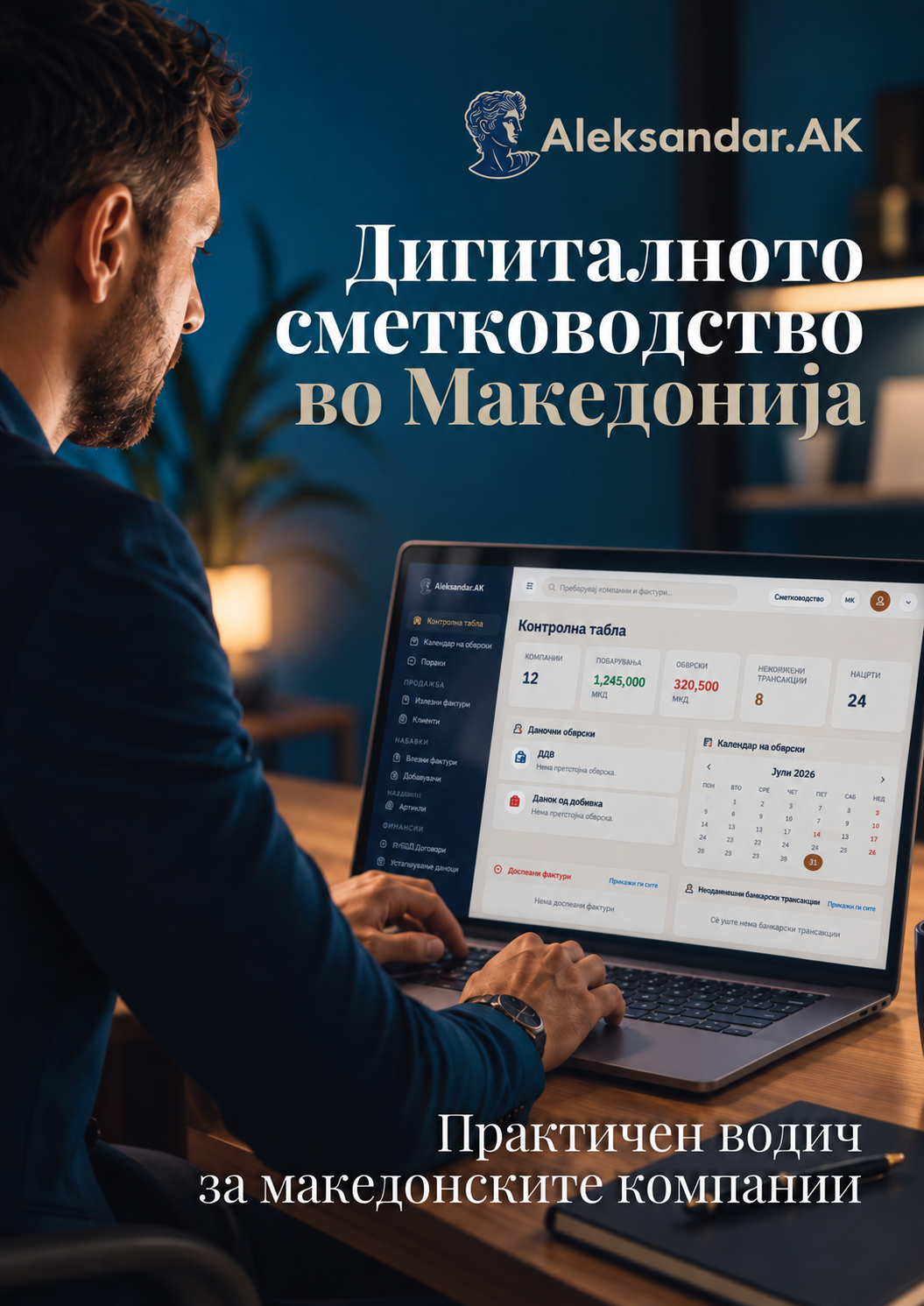
E-Invoicing is one of the most important changes in the way invoicing and accounting operations are handled in North Macedonia. Instead of an invoice being only a document that a company prepares, sends and archives on its own, the new system introduces a structured electronic process in which the invoice is created, signed, delivered and validated through the system of the Public Revenue Office.
For companies, this is not only a technical change. E-Invoicing will affect the way invoices are issued, received, recorded for VAT purposes, communicated to accounting, and organized within business processes. That is why preparation should not be left until the last moment.
Below, we explain what an E-Invoice is, how it works, whom it affects the most, and what steps companies should take while the system is still in the testing phase.
What is an E-Invoice?
An E-Invoice is an electronic invoice in a structured format, delivered through the E-Invoice system and validated by the Public Revenue Office. Unlike a PDF invoice sent by e-mail, an E-Invoice is not merely a visual document, but a data document that can be automatically processed by invoicing, accounting and tax record systems.
In practical terms, this means that the invoice must contain accurate structured data, the appropriate tax treatment, digital signing and successful validation within the system. After successful validation, the invoice receives a unique identifier and becomes part of the digital trail of the transaction.
Why is the E-Invoice system being introduced?
The main purpose of E-Invoicing is to create a clearer, safer and more automated exchange of invoices between companies and institutions. With a central system for recording and validation, business transactions become easier to track, and tax data becomes available in a structured format.
For the state, this means greater transparency and better control over tax flows. For companies, the change may mean less manual data entry, fewer invoice errors and more organized communication between the business and accounting.
What stage is the E-Invoice system currently in?
The E-Invoice system is currently in the testing phase, with the aim of allowing companies, accountants and software solutions to become familiar in time with how it works, its technical requirements and the electronic invoicing process.
Since this is a system that is still being tested and refined, companies should regularly follow the official guidance of the Public Revenue Office and the documentation on eFaktura Wiki, instead of relying on unofficial or outdated information.
The testing phase is a good period for companies to check how they currently issue invoices, whether their software can be adapted, how their VAT indicators are set and how accounting will have timely access to the invoices.
How does the E-Invoice process work?
The E-Invoice process is not just about sending a document. It includes several steps that need to be properly set up before the invoice is delivered.
| Step | What happens | What it means for the company |
|---|---|---|
| 1. Creation | The invoice is prepared in software, a web application or through an integration. | The data must be accurate before sending. |
| 2. Signing | The invoice is signed with a valid digital certificate. | Technical and administrative preparation is required. |
| 3. Validation | The system checks the invoice and its tax treatment. | Errors will need to be corrected before the invoice can move further in the process. |
| 4. Identifier | After successful validation, the invoice receives a unique identifier. | A digital trail of the transaction is created. |
| 5. Delivery | The issuer and the recipient receive a notification about the invoice. | Manual forwarding of documents is reduced. |
Which companies should prepare in time?
Although the system is still in the testing phase, certain companies have a greater need to understand the process in time, because their invoice volume, VAT treatment or software integration may be more complex.
- VAT-registered companies;
- companies with a large number of invoices;
- trading companies and companies with inventory;
- importers and exporters;
- companies with ERP or proprietary software;
- companies working with both domestic and foreign clients.
- whether the software can be adapted;
- who will create and approve invoices;
- which digital certificate will be used;
- whether the VAT treatment is properly set;
- how communication with accounting will be handled;
- how invoices will be archived and tracked.
What changes in accounting?
E-Invoicing will not replace accounting, but it will change the way accounting receives, checks and processes invoices. Instead of invoices arriving by e-mail, on paper or through different channels, the process will move toward centralized and structured exchange.
This means companies will need to define their internal rules much more carefully: who issues the invoice, who checks it before sending, who tracks its status, who accepts received invoices, and how the information reaches accounting.
For accounting, the most important thing will be for the data to be accurate at the moment the invoice is created. If the tax treatment, buyer details, invoice items or total amounts are not entered correctly, the error may appear already during the validation process.
Tax indicators and VAT treatment
One of the most important parts of the system is the proper indication of the tax treatment of the transaction. During the testing phases, the Public Revenue Office places particular emphasis on tax indicators, which show whether the transaction is taxable at the standard or preferential rate, exempt from VAT, outside the scope of VAT, or whether the VAT obligation is transferred to the recipient of the transaction.
This is especially important for companies that have different types of invoices: domestic sales, services to foreign companies, import-export transactions, advance payments, credit notes, or specific VAT regimes.
In such cases, E-Invoicing is not only a matter of technically sending a document. It requires a properly established accounting and tax process before the invoice is even created.
How should a company prepare for E-Invoicing?
Preparation for E-Invoicing should combine technical, accounting and organizational checks.
| Preparation | Question | Why it matters |
|---|---|---|
| Invoicing | Which system do you use to issue invoices? | This determines whether you will use a web application or API integration. |
| Digital certificate | Who will sign E-Invoices? | Signing is part of the legal and technical validity process. |
| VAT treatment | Do the invoices have the correct tax indicators? | Incorrect VAT treatment can create inaccurate records or require corrections. |
| Internal rules | Who creates, checks, sends and tracks invoices? | Clear responsibility reduces the risk of missed or incorrect invoices. |
| Accounting | How will the accountant have access to the invoices? | Timely data exchange and control are required. |
| Archive | How will invoices and their statuses be stored? | The digital trail should be accessible and organized. |
| Testing | Is the company testing the process in time? | Testing reveals technical and organizational issues while the system is still in the testing phase. |
What should a company check now?
Companies should not wait for the system to fully enter practical use before they start preparing. The testing phase can be used to review the current way of working and remove weak points in time.
- whether all invoices are issued with accurate data;
- whether clients and suppliers are properly recorded;
- whether there are different types of VAT treatment;
- whether services are provided to foreign clients;
- whether advance invoices, credit notes or approvals are used;
- whether invoices are stored in an organized manner;
- whether accounting receives all necessary documents on time;
- whether the invoicing software can be connected to the future process.
Frequently asked questions about E-Invoicing
Will a PDF invoice sent by e-mail be enough?
It should not be treated as the same thing. An E-Invoice is a structured electronic invoice that is signed, delivered and validated through the Public Revenue Office system.
Does every company need to have its own software?
Not every company needs to have its own ERP system. During the testing phases, different ways of working are being considered, including a web application for companies that do not have their own invoicing systems.
Does E-Invoicing mean that accounting becomes automatic?
Not entirely. The process will become more digital, but control over tax treatment, deadlines, records and financial statements will still be required.
When should preparation begin?
It is best to begin preparation while the system is still in the testing phase: by checking the software, certificates, internal approvals, VAT treatment and the role of accounting.
How can Aleksandar.AK help?
E-Invoicing is a technical change, but its real impact is accounting-related and organizational. Companies will need to know which data goes into the invoice, how VAT is treated, how the invoice status is tracked, and how accounting receives accurate information on time.
At Aleksandar.AK, we help companies set up the process properly: from reviewing invoicing and VAT treatment to accounting records, digital organization and preparation for electronic invoicing.
Our approach is to connect the company, the accounting team and digital tools into one more organized system, because E-Invoicing should not be only a new obligation, but also an opportunity for better financial operations.
Prepare your company for E-Invoicing
Request support for accounting, VAT treatment, invoicing and digital organization while the system is still in the testing phase.
Timely preparation can help your company understand the new processes more easily, reduce invoicing errors and improve communication between the administrative, financial and accounting parts of the business.